Enclosed spaces. Controlled growing.
Existing warehouses and purpose-designed underground cultivation rooms can become controlled-environment growing spaces. The lighting system supplies the crop light independently of daylight.

LIGHTPIPE / PROTOTYPE LICENSING
Grow in enclosed warehouses and underground cultivation rooms—without relying on natural daylight. Lightpipe V1 mixes selected sources in a configurable driver box, then delivers the light through optical guides around the crop. The cultivator controls the mix from a tablet.
Developed and tested by DragonSun · production-ready prototype · licensing opportunity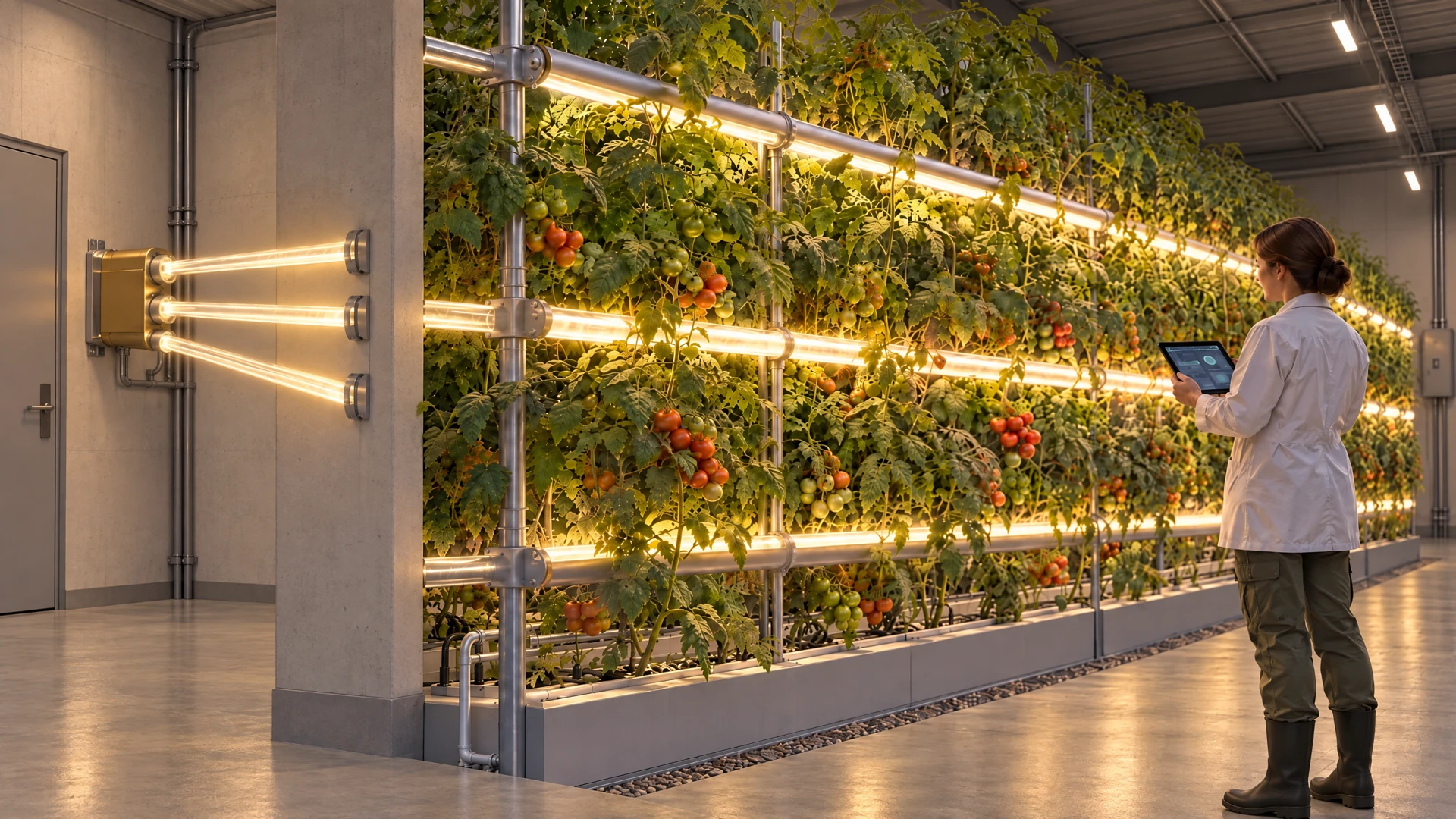
Warehouses. Underground facilities. A different lighting architecture.
Lightpipe brings controlled illumination to enclosed growing spaces. Its driver generates and mixes the light, and optical guides distribute it to the plants independently of daylight.
Existing warehouses and purpose-designed underground cultivation rooms can become controlled-environment growing spaces. The lighting system supplies the crop light independently of daylight.
Instead of relying only on overhead bulb arrays or LED banks, place optical guides around the crop and at the delivery positions the growing layout requires.
Centralized sources provide a common place for lamp servicing, light mixing and source-heat management. The driver and distributed guides do different jobs, rather than placing a separate lamp at every delivery point.
The innovation is the architecture: generate centrally, mix deliberately and deliver where the crop needs it.
A configurable driver combines suitable sources, including LEDs, while optical guides deliver the mixed light. Separating generation from distribution allows canopy-level placement and cultivator control.
WHAT IT DOES
A lighting engine at the source. A delivery system around the crop.
The horticultural V1 system combines already-working lighting and optical-guide technologies in a novel arrangement. Its driver box can use different light sources or combinations of sources, mix the output and send that mix into the pipe. Tablet-based control lets the cultivator adjust the light mix.
The practical difference is where the sources sit: not hundreds of high-power bulbs distributed through the crop space, but a much smaller centralized source group with optical delivery where the plants need light. This reduces the amount of lamp-generated heat placed alongside the crop.
In the modular metal-halide assembly, a lamp sits within an illuminator and highly polished reflector. The reflector shapes the beam entering the lightguide. Inside the guide, 3M™ Optical Lighting Film uses microprisms to control light extraction and provide uniform illumination along its length.
The modular range includes AL6, WL6, AL10 and WL10 assemblies, with component specifications and an industrial lighting layout below.
BUILT AROUND YOUR GROWING SPACE
The light-distribution system is shaped around the grower’s needs—not a fixed pipe size.
Using optical lighting film, DragonSun can make the light-distribution system in any diameter or configuration the grower needs. Individual pipes, a wall of light or a light dome: the form follows the crop and the growing space.
The driver box generates and mixes the light; the optical-film distribution system delivers it in the shape and arrangement the grower requires.

The horticultural application.
Select a light source or combine sources around the intended application. The source box mixes their light before optical delivery.
Separate the lamp location from the light-delivery arrangement. Place the guide around the crop-space requirements instead of relying only on overhead fixtures.
The cultivator controls the selected light mix through a tablet application, bringing light composition into the cultivation workflow.
In the V1 horticultural example, fewer than twenty bulbs in a driver box replace a layout that would otherwise use hundreds of 1000-watt bulbs in the growing space.
Jason Thon · founder and Head of R&D
In the horticultural system, the driver concentrates the lamps and their source heat away from the crop, while optical guides deliver light with very low loss. Source counts and light mixes are selected for the growing layout. The industrial photometric example below documents a separate modular installation.
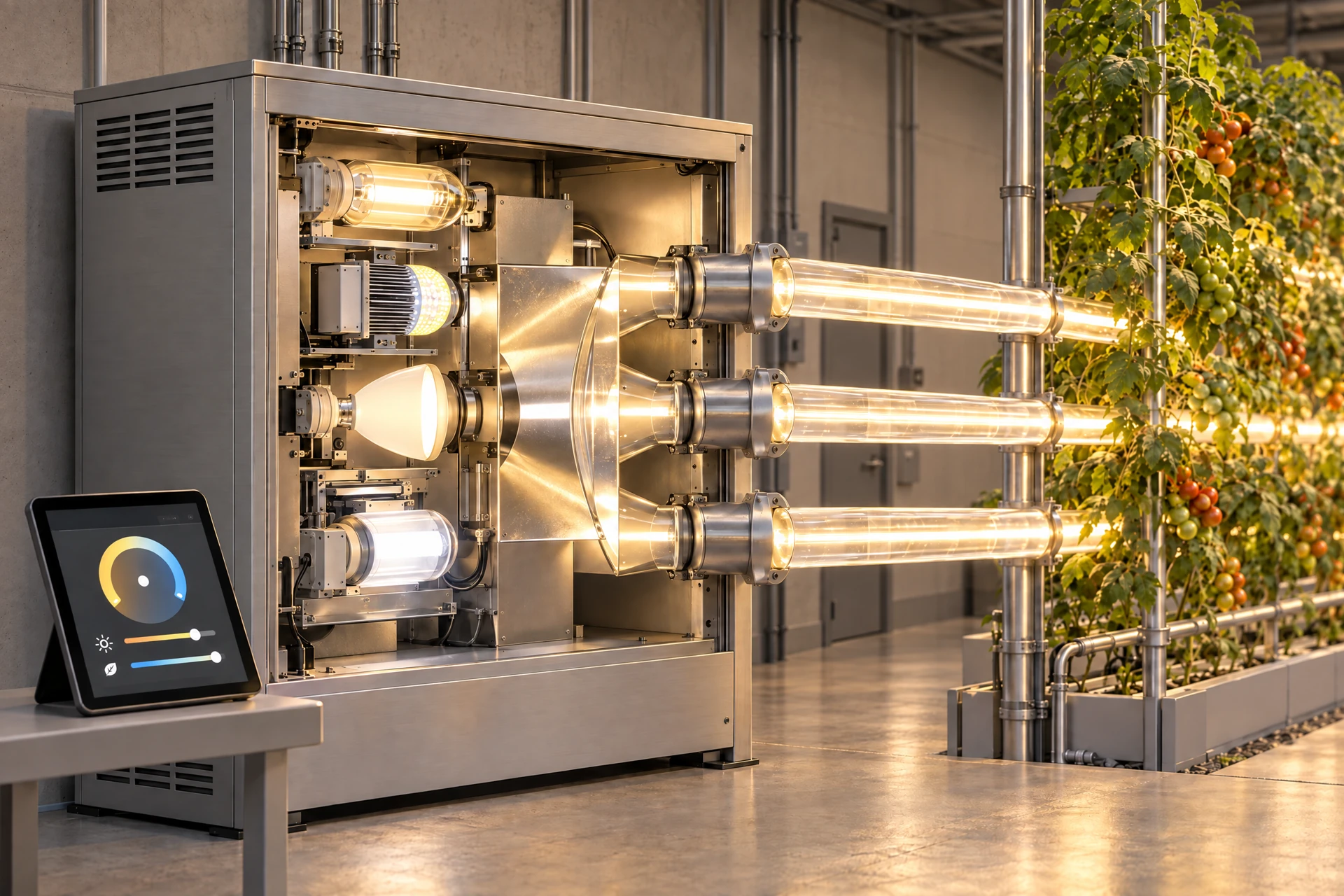
Lamp → reflector → optical guide → distributed illumination
The illuminator houses the lamp/socket and reflector. The computer-aided reflector design uses highly polished aluminum Alzak to shape the beam for clean, even distribution through the guide.
3M’s microprismatic Optical Lighting Film is the optical component inside the tube. The microprism structure guides the light and controls its extraction, projecting illumination along the length of the lightguide.
Modules offer 90°, 120°, 180° and 270° light distributions. Guide, housing and mounting configurations are selected for the installation.
A source, an optical structure and a mechanical system engineered as one assembly.
Modular construction and service access.
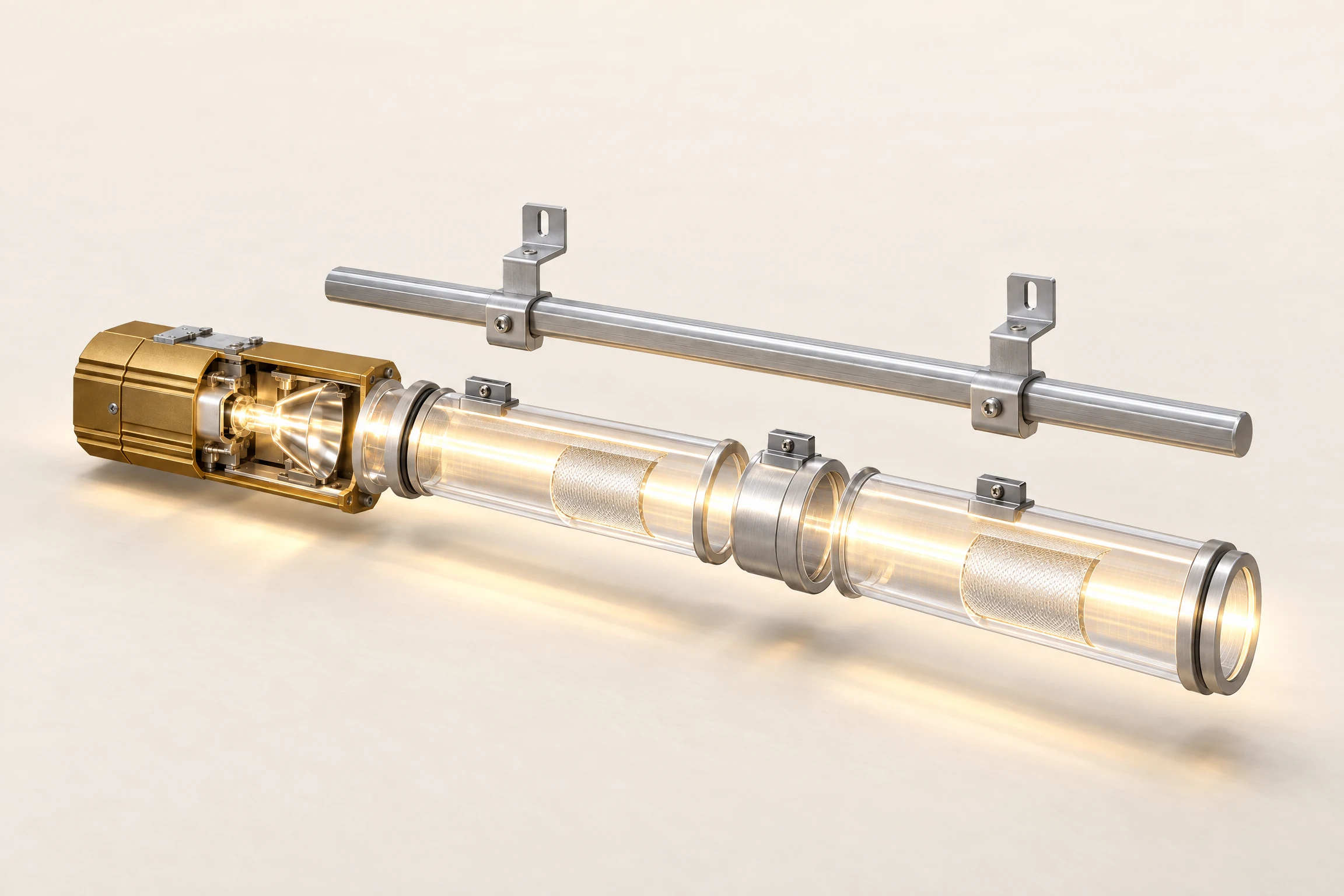
AL6 uses 6½-inch modules in 8-foot sections, up to 40 feet overall. AL10 and WL10 use 10-inch modules in 6.5-foot sections, up to 65 feet, with custom 8- and 10-foot sections available.
The guide has a UV-stabilized, matte-finished polycarbonate outer shell. Self-aligning connectors or tool-less coupling devices join the modules. Molded coupling clamps cover the guide collars and seal adjoining sections.
Hinged ballast enclosures provide access for maintenance. Rails and hangers allow the modules to slide for linear thermal expansion. The bridge bracket can reduce the number of mounting points by 40% while allowing thermal movement.
3M photometric data in the original Lightpipe brief.
The original industrial-area sheet records a 95-by-125-foot installation, twenty lightguides and maintained illumination at a 2.5-foot workplane.
Average maintained illumination
Maximum / minimum
Light Loss Factor
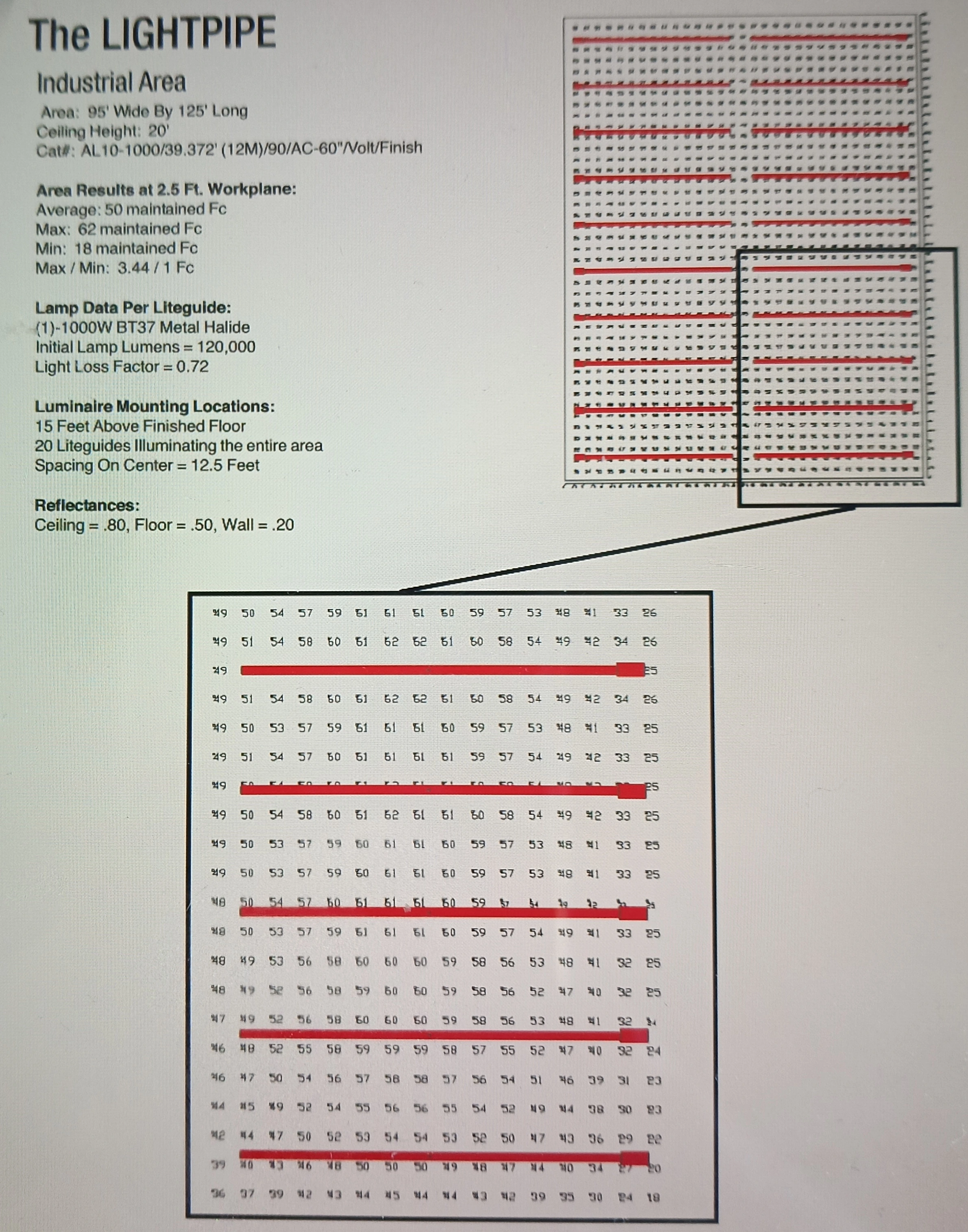
| Parameter | Recorded value |
|---|---|
| Area | 95 ft wide × 125 ft long |
| Ceiling height | 20 ft |
| Original catalogue configuration | AL10-1000/39.372' (12M)/90/AC-60"/Volt/Finish |
| Workplane | 2.5 ft |
| Average illuminance | 50 maintained footcandles |
| Maximum / minimum | 62 / 18 maintained footcandles |
| Max:min ratio | 3.44:1 |
| Lamp per lightguide | One 1000 W BT37 metal-halide lamp |
| Initial lamp lumens | 120,000 |
| Light Loss Factor | 0.72 |
| Mounting height | 15 ft above finished floor |
| Layout | 20 lightguides; 12.5 ft on-centre spacing |
| Reflectances | Ceiling 80%; floor 50%; wall 20% |
Source: original Lightpipe industrial-area sheet, with 3M photometric data attributed by inventor Jason Thon. Values describe the illustrated industrial configuration.
AL6 · WL6 · AL10 · WL10
Explore the construction, optical film, mounting and lamp specifications for AL6, WL6, AL10 and WL10. The dimensions and component ratings describe these modular assemblies; custom horticultural systems are built to the grower’s required diameter and configuration.
The hinged ballast enclosure is constructed of ribbed aluminum and a tool-less stainless steel hinge, allowing for ease of maintenance. All HID ballasts are integral high power factor, electromagnetic core & coil. All surfaces are pretreated with a phosphate wash and texture powder coated to a 3 mil thickness. Underwriters Laboratories and Canadian Standards approved for damp locations.
Constructed of ribbed extruded and die-formed aluminum for optimum cooling. The Illuminator houses the reflector and lamp/socket assembly. All surfaces are pretreated with a phosphate wash and texture powder coated to a 3 mil thickness. Underwriters Laboratories and Canadian Standards approved for damp locations.
A 1" X 1" rail is anodized extruded aluminum. Rails lock together with self-aligning connector brackets. The rail allows for surface, aircraft cable, pendant and extended arm mountings. The rail and mounting clamps allow the modules to slide freely to compensate for linear thermal expansion and varying mounting positions.
The clamp is mounted at every Liteguide connector and easily mounts to the rail with two stainless steel fasteners per clamp (supplied). Clamp is painted semi-gloss white.
OLF film is a patented plastic film technology composed of microprisms designed to extract and project light providing uniform illuminance along the entire length of the liteguide.
6-1/2" diameter modules are available in 90°, 120°, 180° & 270° distributions. Modules are supplied in 8' sections with an overall maximum length of 40'. Modules have an outer shell of UV stabilized, matte finished polycarbonate and includes a self-aligning connector tube that locks adjacent modules together. For use in interior and exterior applications.
Computer-aided reflector design in highly polished aluminum Alzak optimizes the beam pattern across the lightguide modules for clean, even distribution.
Die formed and completely sealed with closed cell memory retentive gaskets. All ballasts are integral, high power factor, electromagnetic core & coil. All surfaces are pretreated with a phosphate wash and texture powder coated to a 3 mil thickness.
Constructed of die-formed non-corrosive aluminum. The housing is completely sealed with closed cell memory retentive gaskets. The Illuminator houses the reflector and lamp/socket assembly. All surfaces are pretreated with a phosphate wash and texture powder coated to a 3 mil thickness. Underwriters Laboratories and Canadian Standards approved for wet locations and European standard IP65 approved.
Used to suspend the liteguide modules directly to support structure or to mounting hardware. The standard hanger bracket is designed to allow liteguide modules to slide freely allowing for linear thermal expansion. A labor saving “Bridge Bracket” can be specified to mount between the coupling clamp. The bridge bracket is a labor saving device that can reduce the number of mounting points by 40% and still allow for linear thermal expansion.
The clamp is constructed of white molded polycarbonate and is used to cover the liteguide collars and seal liteguide sections together without the use of tools.
OLF film is a patented plastic film technology composed of microprisms designed to extract and project light providing uniform illuminance along the entire length of the liteguide.
10" diameter modules come in 90°, 120°, 180° & 270° distributions. Modules are supplied in 6.5' sections with an overall maximum length of 65'. Custom 8' & 10' sections are available. Modules have an outer shell of UV stabilized, matte finished polycarbonate and include a tool-less coupling device to align and lock adjacent modules together. Not suitable for exterior applications.
Computer aided design, highly polished aluminum Alzak. The reflector is designed to optimize the beam pattern across the span of liteguide modules for clean even distribution through liteguide. A 1000W Metal Halide, 110,000 initial lumens, mogul base BT37 lamp is supplied. A T25 Metal Halide lamp is available as an option. All lamps are 4000° Kelvin.
The hinged ballast enclosure is constructed of ribbed extruded aluminum and a tool-less stainless steel hinge, allowing for ease of maintenance. All HID ballasts are integral high power factor, electromagnetic core & coil. A remote NEMA ballast housing is available. All surfaces are pretreated with a phosphate wash and texture powder coated to a 3 mil thickness. Underwriters Laboratories and Canadian Standards approved for damp locations.
Constructed of ribbed extruded and die-formed aluminum for optimum cooling. The Illuminator houses the reflector and lamp/socket assembly. All surfaces are pretreated with a phosphate wash and texture powder coated to a 3 mil thickness. Underwriters Laboratories and Canadian Standards approved for damp locations.
Used to suspend the liteguide modules directly to support structure or to mounting hardware. The standard hanger bracket is designed to allow liteguide modules to slide freely allowing for linear thermal expansion. A labor saving “Bridge Bracket” can be specified to mount between the coupling clamp. The bridge bracket is a labor saving device that can reduce the number of mounting points by 40% and still allow for linear thermal expansion.
The clamp is constructed of white molded polycarbonate and is used to cover the liteguide collars and seal liteguide sections together without the use of tools.
OLF film is a patented plastic film technology composed of microprisms designed to extract and project light providing uniform illuminance along the entire length of the liteguide.
10" diameter modules come in 90°, 120°, 180° & 270° distributions. Modules are supplied in 6.5' sections with an overall maximum length of 65'. Custom 8' & 10' sections are available. Modules have an outer shell of UV stabilized, matte finished polycarbonate and include a tool-less coupling device to align and lock adjacent modules together. Not suitable for exterior applications.
Computer aided design, highly polished aluminum Alzak. The reflector is designed to optimize the beam pattern across the span of liteguide modules for clean even distribution through liteguide. A 1000W Metal Halide, 110,000 initial lumens, mogul base BT37 lamp is supplied. A T25 Metal Halide lamp is available as an option. All lamps are 4000° Kelvin.
Die formed and completely sealed with closed cell memory retentive gaskets. All ballasts are integral, high power factor, electromagnetic core & coil. All surfaces are pretreated with a phosphate wash and texture powder coated to a 3 mil thickness.
Constructed of die formed non-corrosive aluminum. The housing is completely sealed with closed cell memory retentive gaskets. The Illuminator houses the reflector and lamp/socket assembly. All surfaces are pretreated with a phosphate wash and texture powder coated to a 3 mil thickness. Underwriters Laboratories and Canadian Standards approved for wet locations and European standard IP65 approved.
Used to suspend the liteguide modules directly to support structure or to mounting hardware. The standard hanger bracket is designed to allow liteguide modules to slide freely allowing for linear thermal expansion. A labor saving “Bridge Bracket” can be specified to mount between the coupling clamp. The bridge bracket is a labor saving device that can reduce the number of mounting points by 40% and still allow for linear thermal expansion.
The clamp is constructed of white molded polycarbonate and is used to cover the liteguide collars and seal liteguide sections together without the use of tools.
OLF film is a patented plastic film technology composed of microprisms designed to extract and project light providing uniform illuminance along the entire length of the liteguide.
10" diameter modules come in 90°, 120°, 180° & 270° distributions. Modules are supplied in 6.5' sections with an overall maximum length of 65'. Custom 8' & 10' sections are available. Modules have an outer shell of UV stabilized, matte finished polycarbonate and include a tool-less coupling device to align and lock adjacent modules together. Not suitable for exterior applications.
Computer aided design, highly polished aluminum Alzak. The reflector is designed to optimize the beam pattern across the span of liteguide modules for clean even distribution through liteguide. A 1000W Metal Halide, 110,000 initial lumens, mogul base BT37 lamp is supplied. A T25 Metal Halide lamp is available as an option. All lamps are 4000° Kelvin.
Discuss the configuration, installation requirements and intended application with DragonSun.
THE NEXT CONVERSATION